
One Integration, Hundreds of Assets: Solving RWA Fragmentation
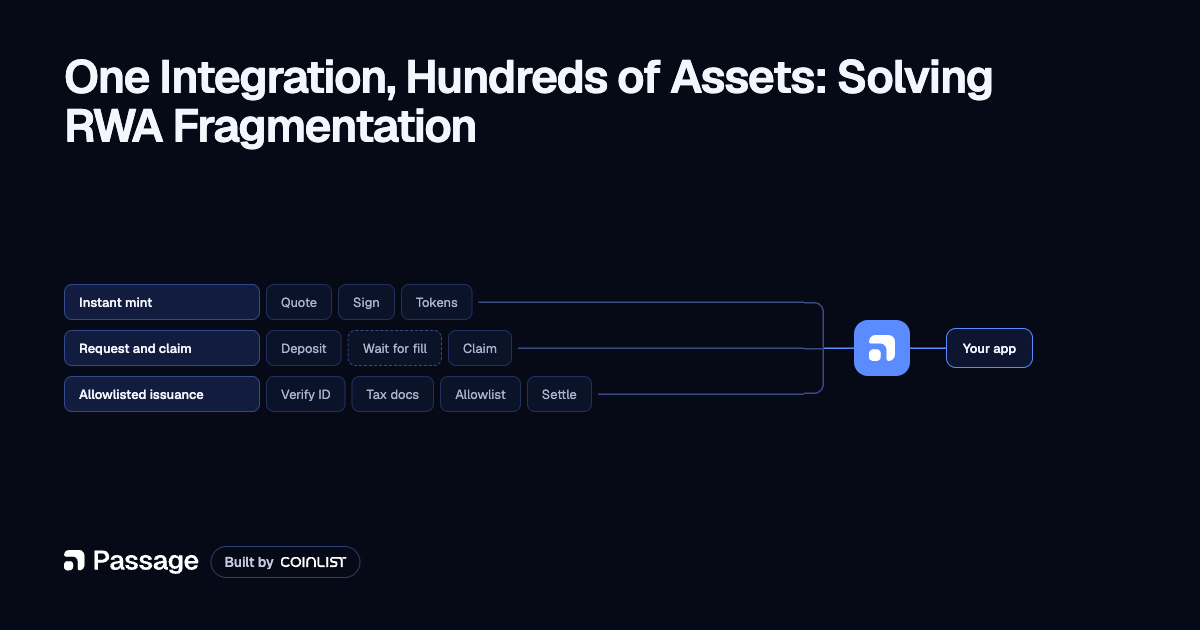
Your users hold stablecoins that earn nothing. Tokenized Treasury and bond funds can put those balances to work without the smart contract risk of lending pools. But the moment you look at offering them, you find there is no single market to plug into. Each issuer runs its own purchase flow, its own eligibility rules, and its own settlement model. Offering three kinds of tokenized assets can mean building three different products.
This post compares how those workflows actually differ, why the differences are the expensive part, and how Passage by CoinList puts them behind one integration.
Why tokenized assets are fragmented
Tokenized assets are built by different issuers, under different legal structures, for different investors. That shows up in four places your app has to handle.
How a purchase settles. Some tokens are minted the moment the user pays. Others work like a mutual fund: the user places a request, and the fund fills it days later.
Who can buy. Eligibility is set by each issuer and each asset. Ondo's tokenized assets, for example, are only for eligible non-US investors, and the restricted list includes Canada. Other issuers restrict different countries.
What compliance looks like. Some issuers need no direct identity check with the issuer. Others require full identity verification and tax documents before a user can buy. Almost all require ongoing wallet screening.
When it trades. Trading windows differ by asset, from around the clock to US market hours only, and some products don't trade in sessions at all.
None of these is hard on its own. The problem is that each issuer combines them differently, and your app has to get every combination right.
Three settlement models, side by side
Here is how three common models compare in practice.
1. Instant mint and burn (request for quote). The user requests a quote, pays in USDC, and the tokens arrive in the same transaction. Selling works the same way in reverse. Ondo's tokenized Treasury and bond ETF trackers work like this, for example SGOVon (a tokenized tracker of a 0 to 3 month Treasury bond ETF) and BILon (a tokenized tracker of a 1 to 3 month T-bill ETF). The minimum is $1 and fractional amounts are supported. Your app needs a quote step, a signature, and a clear message when a quote expires.
2. Request, fill, and claim. Some tokenized funds don't settle instantly. The user deposits USDC, the fund fills the request on its dealing schedule, and the user claims the tokens once it does. A request placed outside a dealing day waits for the next one, and it can't be cancelled. Your app needs pending states, a claim step, and copy that never calls the product instant.
3. Direct issuance with per-offer allowlisting. For assets the user owns directly, such as tokenized equities, each wallet must be allowlisted for each offer before it can settle. That takes identity verification, tax documents, and an onchain signature. Your app needs an onboarding path that collects all of it before the first purchase.
[Diagram placeholder: Alex's three settlement models graphic goes here.]
Each model is its own state machine, its own error handling, and its own support questions. Teams we talk to tell us a single issuer integration can take up to three months. Adding a second and third is not much faster, because the second issuer rarely works like the first.
What fragmentation costs your users
The engineering time is only part of it. Fragmentation also shows up in your product.
More sign-ups. Without a shared identity layer, each issuer that requires verification can mean another redirect and another form. One team told us redirect KYC was a real pain point with a provider they had used.
Unclear availability. If eligibility lives in three systems, users find out they can't buy at the last step.
A thin shelf. When every new asset is a new project, most teams ship one and stop. Your users get one yield product instead of a choice of durations and risk levels.
How Passage unifies the workflow
Passage by CoinList is one integration between your app and a growing catalog of tokenized assets. You build the experience; Passage runs the middle and back office.
One SDK and API for the whole lifecycle. Onboarding, investing, selling, and claiming run through the same SDK and API. Ready-made React components cover offers, requirements, checkout, and claims, or you can build your own UI on the hooks.
One requirements check per offer. Before a purchase, Passage tells your app what a user still needs for that specific offer, whether that is an eligibility check, a document, or an allowlist signature. You show one checklist instead of writing issuer-specific logic.
One identity layer, two ways in. Users can sign in with CoinList through OAuth inside your app, verify once, and carry that identity across offerings. For some offerings, users can instead sign in with just a wallet, with no CoinList account, under permissions your team sets and is responsible for.
Compliance handled per asset. Passage applies each issuer's rules: compliance screening, eligibility by jurisdiction, issuer allowlists, ongoing wallet screening, and identity verification where the issuer requires it.
Assets, not issuers. You choose which assets and asset types to offer, from tokenized Treasury and bond funds to stocks, ETFs, and commodities: 400+ assets through the same integration. New assets arrive as new offers in your existing integration, not as new projects on your roadmap.
Non-custodial. Users hold assets in wallets they control. The money-movement contracts were audited by Oak Security and are public on GitHub.
Passage is built on CoinList's infrastructure: 12M+ verified users in 150+ countries, $1.2B+ raised, and $40B+ in distributed assets. Purchases run on Ethereum today.
Questions teams ask us
Is there one API for multiple tokenization platforms? Yes. Passage gives your app one SDK and API across issuers, and each asset keeps its own settlement model behind the same interface.
Do my users need to verify with every issuer? No. Where an issuer requires identity verification, users verify once through Passage. Some assets need no identity check with the issuer at all.
Can US users buy? Most assets on Passage are for eligible non-US users only. Eligibility depends on the issuer, the asset, and the user's jurisdiction, and Passage checks it for every offer.
What happens when an issuer adds assets? They appear as new offers in your existing integration. You decide whether to show them.
See it working
Want to offer yield on your users' balances? Talk to the Passage team →
Disclosures: Tokenized assets on Passage are available only to eligible users, subject to issuer, offering, and jurisdictional restrictions. Ondo assets are available only to eligible non-US investors. Ondo tokens provide economic exposure to the underlying asset and do not confer ownership rights in the underlying company's shares. Returns are not guaranteed and the value of an investment can go down. This post is for information only and is not investment, legal, or tax advice.