
One Integration for Tokenized Real-World Assets, and Next, Permissioned Pools
On November 9, Formation Securities notified the SEC that it intends to operate the first tokenized securities venue (TSV) on Solana, using trading technology licensed from Orca. The announcement names Passage by CoinList as a distribution partner for the venue. Trading is expected to begin in early 2027. Tokenized shares of Exodus Movement, Forward Industries, and Galaxy Digital are anticipated at launch, and Superstate and Securitize are expected to make the shares available.
Passage already gives apps one integration for tokenized real-world assets, from yield-bearing Treasury and credit funds to tokenized stocks, for eligible users. This post explains what permissioned pools mean for DeFi applications, and how Passage plans to give your users access to permissioned trading and lending pools through the same integration.
Regulated assets trade in permissioned pools
The SEC's Innovation Exemption permits secondary trading of eligible tokenized stocks through permissioned automated market maker pools on qualifying venues. Eligible tokenized stocks must provide the same rights as traditional shares, including voting and dividend rights.
The same model already exists elsewhere in DeFi. In July, Uniswap Labs introduced Permissioned Pools, a hook standard for Uniswap v4 built in collaboration with Superstate, Securitize, and Dowgo. The issuer keeps control of the allowlist, and eligibility checks happen at the protocol level. On the lending side, Aave Horizon lets qualified users borrow stablecoins against tokenized real-world assets, with collateral limited to wallets that each issuer has allowlisted.
In each case the pool is onchain and users hold their own assets, but only verified wallets can take part.
Every issuer keeps its own allowlist
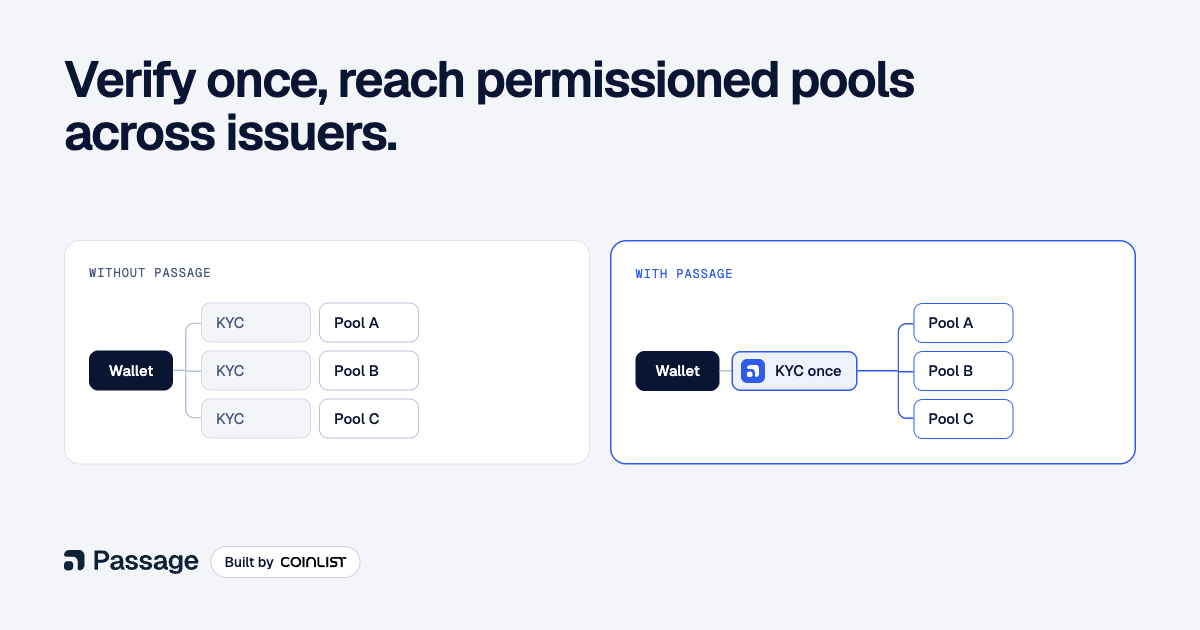
A permissioned pool checks each wallet against the issuer's allowlist. Each issuer runs its own onboarding, so a user who wants assets from two issuers completes KYC twice, and an app that wants to support both builds two integrations. Each new issuer, venue, and chain adds to that work.
For users, that means repeating identity checks before a first trade. For apps, it means compliance work that grows with every asset added.
How Passage works
Passage is CoinList's SDK for offering tokenized real-world assets through a single integration. For permissioned pools, it is planned to work in three steps:
- The user completes KYC once with Passage.
- The user links their wallet to their Passage profile, which is how the wallet is expected to get onto the allowlist.
- Passage checks whether the user is eligible to trade or lend each asset.
Users keep self-custody throughout. Your app integrates Passage once instead of integrating each issuer.
For aggregators and trading front ends
Permissioned pools hold liquidity that your users can't reach until their wallets are approved. Passage plans to let a user who verifies once trade in permissioned pools across issuers from the wallet they already use, including Permissioned Pools on Uniswap v4 and, when it launches, Formation's venue on Solana.
For lending and vault apps
Tokenized stocks and funds are being used as collateral, and the same allowlist rules apply to borrowers. Passage plans to offer permissioned borrowing and lending access that works the same way as trading access: one KYC, one linked wallet, and an eligibility check for each asset. Formation's announcement also says holders are expected to be able to use their shares across approved onchain applications.
Get ready before trading opens
Formation expects trading to begin in early 2027. Teams that integrate now can have users verified before the first pools open. Passage also gives partners access to a catalog of more than 470 tokenized assets across stocks, fixed income, and commodities for eligible users.
Building an aggregator, a trading front end, a lending market, or a vault product? Talk to the Passage team →
This post describes planned products and third-party announcements. Availability depends on jurisdiction and eligibility requirements, and timelines may change. Nothing here is an offer to sell or a solicitation of an offer to buy any security.